Week 3 of my AI-inspired short fiction project:

Annihilation

In a remote quadrant of the Eridani system, Eurydice drifts towards a final fiery cataclysmic embrace with the seething surface of Veridium, the main sequence star she is falling into. Eurydice, battered and crippled, her main drive non-functional, and many of her operational systems damaged beyond repair, is little more than a floating tomb, but within this metallic sepulcher, life still survives. Amidst the erratic clamor of dying systems, Elara Valen is still plugged in to the ship’s AI, struggling to keep control of the once mighty vessel.

Elara, of the proud Uxari race, keepers of knowledge scattered among the stars, is a specialist in alien bio-technology, chosen for her expertise in the obscure achievements of galactic life. The lone survivor of a once-thriving crew, she is now a solitary sentinel, the sole observer and participant in Eurydice’s last waltz into oblivion.

Around her, the ship’s control room glows spectrally, bathed in eerie crimson fingers of light that cast elongated shadows on the walls. Elara stays planted in her seat at the helm, her delicate appendages dancing over the console, attempting to extract one final kernel of possibility from the ship’s computer. That AI, a synthetic entity of often sarcastic intellect named Echelon, murmurs to her, whispering data and dire predictions in her auditory interface.

Approaching Veridium in T-minus sixty minutes, Dr. Valen,” Echelon intones dryly.

Elara’s faceted emerald eyes stare into the abyss. In this infinite void and over the course of Eurydice’s long voyage, she has discovered wonders beyond imagination – ancient civilizations etched into the surface of desolate planets, sentient clouds that whisper secrets of the cosmos, and luminous creatures that defy comprehension. Her life’s work has been a tapestry of interstellar marvels, but now, it is all unraveling into nothingness.

She has learned much during her solitary vigil. The alien species that created the starship Eurydice disappeared from the universe long ago. When salvaged, she was a ghost ship, filled with enigmatic contraptions. It was specialist Elara who deciphered some of their arcane technology. It is why she is onboard Eurydice now. But is it all for naught? 

As the ship drifts closer to the surface of Veredium, it is clear that the ancient architects designed it for a singular purpose: to return to the heart of the cosmic furnace from whence they came. The Veredium system is the genesis of Eurydice’s creators, a discovery that seems more and more meaningless as the minutes go by.

The countdown to oblivion continues and Elara’s thoughts turn to the many souls who once shared her journey. Their laughter, camaraderie, and dreams now seem to echo eerily in the empty corridors, ghosts populating the darkening shadows with glimpses of what once was. One by one they vanished, consumed by time and the relentless decay of the ship’s systems. Of all of Eurydice’s varied crew, Elara is the only being not completely biological. Her bionic enhancements, implanted to enhance her compatibility with alien machine systems, make her more akin to Echelon than the rest of her now-defunct crew.

Approaching star in T-minus thirty minutes, Dr. Valen,” Echelon drones.

Echelon is sentient, but empathy is not a trait of the AI. Sometimes he seems to take a perverse delight in the misfortunes of those he serves.

Elara knows she is alone in this part of the universe. The Eridani system lies on the edge of known space. Her heart aches for the worlds she has left behind, for the possibilities that perished with her crew. But lately, she also harbors a strange yearning to join the cosmos, to become a part of the radiant tapestry that stretches across the heavens. It is tiring being alone. And Elara has been alone for a long time.

It is time now. Time to execute the decision she has been toying with for days, time to implement the last mystery of Eurydice’s builders, something she deciphered only weeks ago just before Veredium’s gravity well captured Eurydice. 

“Echelon, please activate ship’s final protocol,” she says, pleased that there is not the slightest tremor in her voice.

Are you sure, Dr. Valen?” 

Is that surprise in Echelon’s voice? “Quite sure, Echelon. I repeat, please activate ship’s final protocol.”

Of course, Dr. Valen. Activating final protocol now.” Echelon’s tone is matter-of-fact now. “Final protocol parameters are now operational.”

The starfield in the viewscreens shifts slowly as Eurydice begins to swing around until she is head-on to the blazing surface slowly filling the screens. Elara spends a brief moment pondering how the ship can maneuver without power, then dismisses the thought. Whatever has control of Eurydice now is not connected to either the ship’s systems or the AI.

The hull begins to hum with energy as it absorbs the outflung radiation of the approaching star’s embrace. Eurydice’s journey will end the way it began, a celestial phoenix immolating itself in cosmic fire. And with that journey’s end, Elara’s own journey will come to an end too.

The ship’s walls pulse with ethereal light and Elara’s face stretches into a fragile smile. She has chosen to embrace the void, to surrender to the unknown. In these final moments, she is not just a passenger on the ship; she is a part of the grand narrative of the universe itself.

Smiling, she transmits a final message, a farewell to the universe that bore her and now consumes her. Her voice, a haunting melody of melancholy, echoes through the confines of the console room.

“I am Elara of the Uxari, the last of my kind,” she intones. “I carry with me the sum of our knowledge, the dreams of a civilization lost to time. As I approach the embrace of this blazing star, I offer our legacy to the cosmos. Let it be known that we existed, that we sought to understand the mysteries of the universe, and that we did not go quietly into the night.”

Approaching stellar surface in T-minus ten seconds,” Echelon announces. “Goodbye, Dr. Valen.” 

Elara closes her eyes, whispering farewell to the stars that have been her constant companions, and the cosmic current carries her away, a solitary voyager merging with the infinite.

Week 2 of my AI-inspired short fiction project:

IMAGINATION

The sun hung low in the sky, casting long shadows across the small town of Willowbrook. The year was 1955, and life in Willowbrook had a way of unfolding like a well-worn storybook, its pages filled with the ordinary and the extraordinary in equal measure.

In the heart of town stood a peculiar shop, its windows cluttered with curiosities from times long past. A hand-painted sign above the door read, “Mister Cogsworth’s Oddities and Antiques.” The townsfolk whispered tales of the shopkeeper, an enigmatic man named Augustus Cogsworth, who had lived in Willowbrook for as long as anyone could remember.

One hot July afternoon, a certain young lad named Thomas Jenkins ventured into the dusty emporium, his curiosity piqued by the shop’s mysterious allure. A tinkling bell announced his arrival, and the air was thick with the scent of old books and forgotten memories.

Mr. Cogsworth, a man of indeterminate age with a shock of white hair and round spectacles perched on his nose, emerged from the shadows. His eyes gleamed with a knowing twinkle as he appraised the boy.

“Welcome, young sir,” he said in a voice that seemed as ancient as the relics that surrounded them. “What brings you to my humble establishment today?”

Thomas, his voice barely more than a whisper, replied, “I heard you have things… things that are, well, peculiar.”

Cogsworth grinned, revealing a set of yellowed teeth. “Ah, peculiarity is my specialty, dear boy. Come, let me show you.”

The shop was a labyrinth of curiosities—a stuffed two-headed squirrel, a jar containing what appeared to be a miniature thunderstorm, a carousel horse suspended from the ceiling, and a dusty typewriter that Thomas was convinced had once belonged to a famous writer.

As they explored, Mr. Cogsworth regaled Thomas with stories of the oddities’ origins. The thunderstorm in a jar had been captured on a moonlit night by a lovesick meteorologist. The carousel horse was said to have carried a dreamer to far-off lands in the dead of night. The typewriter had once been the muse of a struggling author until it mysteriously vanished, leaving behind only half-finished tales.

Thomas listened with rapt attention, his imagination set ablaze. Hours passed like mere seconds, and when he finally left the shop, the sun had dipped below the horizon, painting the sky with hues of orange and purple.

That night, Thomas couldn’t sleep. His dreams were filled with visions of extraordinary adventures, and he longed to experience the peculiar wonders that Mr. Cogsworth’s shop held within its walls.

Over many following weeks, Thomas became a frequent visitor to the shop. He spent hours listening to Mr. Cogsworth’s stories, absorbing the magic of each peculiar item. And in return, he shared tales of his own, spun from his vivid imagination.

One afternoon in the late fall, as the sun cast long shadows across the streets, Thomas made a discovery of his own. Hidden beneath a pile of old newspapers, he found a dusty tome filled with handwritten pages. The book’s cover bore a single word: “Imagination.”

Thomas opened the book, and as he read its pages, he felt a rush of inspiration like never before. The words seemed to come alive, dancing across the paper, forming stories and dreams that were uniquely his own.

From that day forward, Thomas became a storyteller, weaving tales of peculiarity and wonder that captured the hearts of his fellow townsfolk. And he continued to visit Mr. Cogsworth’s shop, although their interactions had changed. Mr. Cogsworth invariably met him with a knowing smile, and he treated him as an equal now. It came as no surprise when one day, Mr. Cogsworth whispered to him that he would soon be leaving Willowbrook, and he would like Thomas to be in charge of the shop from now on.

“You should change the name of the shop,” he said, with a mysterious glint in his eyes. “Maybe you should call it Imagination.”

(658 words)

TOMORROW’S NEWS

TOMORROW’S NEWS – A noir short fiction story

I’m reading about my death. A three-sentence story, circled in red on a single sheet of paper and stuffed in my mailbox, it’s similar to the others I’ve received over the past two weeks, but this one is different, in a very personal way, obviously.

The first one I receive, I nearly throw out as junk mail, but something outlined in bold red ink catches my eye and I open it.

It’s a simple broadsheet, containing an eclectic collection of stories that could belong on the pages of any local tabloid. The highlighted one stands out because it’s dated tomorrow. It describes an accident on Old Mill Road, a half mile from where I live, and involves a fatality.

I put the whole thing down to an elaborate practical joke and throw the paper in the kitchen trash.  Imagine my surprise when I turn on the TV next morning and watch the female anchor reporting an accident on Old Mill Road, exactly as described in yesterday’s mystery paper.

I go back to the recycling bin, and fish out the news sheet, all crumpled and slightly dog-eared, but still legible and still as preposterous as when I first read it eighteen hours ago. On an impulse, I smooth it out on the kitchen table and put it into the sideboard drawer. Then I forget all about it until I go out the mailbox later that morning and find another sheet, neatly folded like the previous one, sitting at the bottom of the box.

This one I open before any other piece of mail that day. Just like previously, it contains a small set of stories with one outlined in red and datelined the next day. That’s tomorrow. This time I don’t trash the sheet. I leave it face up on the kitchen table where I will see it when I come down next morning. It’s the last thing that catches my eye before I go to bed that night.

Next morning, I’m up uncharacteristically early, seated at the table with my morning coffee mug, a full ten minutes before the newscast begins. Yesterday’s paper is spread out on the table, waiting for confirmation, and I keep glancing at it, although I know the content of the circled story by heart already. It’s a full forty minutes into the program before the anchor mentions a tree branch falling on someone sitting on a bench in Marley Park, killing her instantly. Exactly as laid out in the now slightly sinister looking paper in front of me.

And so on for two weeks, until I’m taking the predictions for granted, even though I can’t stifle a growing sense of unease. Why am I getting these sheets? Am I the only one receiving them? I’ve chickened out of querying my neighbors about it.  They already look at me sideways because I don’t have a regular job.  That news sheet is always the first piece of mail I open and I always leave it on the kitchen table before I go to bed.

Today, my growing feeling of discomfort bursts like a squeezed boil. Today’s news concerns me.

The ominous red-circled story on the page makes my heart nearly stop. I re-read it to ensure that I’m seeing it right. It says:

Yesterday, an Avalon, New York man, Carl Smyth, was found dead in his home. There were no obvious signs of trauma, but a cryptic note that read “tomorrow’s news today” was found clutched in the dead man’s hand. The authorities are asking for help from anyone with knowledge of this incident.

That’s me, Carl Smyth. According to this piece of paper, I’m going to die sometime later today, under mysterious circumstances.

I panic completely. It’s 11:00 AM and there are still thirteen more hours in the day. Scrambling back to the house, I lock and bolt the front door. I’m hyperventilating, leaning on the wall trying to pull myself together, trying to rationalize what I’ve just read.

For a brief moment, I’m tempted to dismiss this whole situation as crazy nonsense, but cold logic informs me that every single one of the past two weeks’ highlighted stories have been deadly accurate. I have a funny feeling in my belly. Needing to be pro-active about this whole thing, I sprint around the lower level of the house, obsessively closing and locking all the entrances and windows, then double checking them again and again. For good measure, I go upstairs and do the same for all those windows too. I draw all the blinds, trying to convince myself that if no one could see inside they might think I’m not home. But who are they, anyway? I have no idea what form or shape the threat will take. I pace around the living room. I lock and bolt the door to the basement without even going down there to check. I go upstairs and pace some more, then come back downstairs and do the same, getting angrier and more terrified by the minute.

Lunch time and dinner time ooze by like molasses. I can’t eat anything. I’m not hungry. I feel like throwing up.

It’s 10:00 PM, and dark outside. I’m seated at the kitchen table watching the hands of the wall clock crawl around with agonizing slowness. Usually, I’m in bed by this time. I’m an early sleeper, but I’m certainly not sleeping tonight. Every light in the kitchen is turned on, as well as all those in the hallway and upstairs too. I don’t want any shadows or dark corners tonight.

Waiting for time to pass is an excruciating pastime. I can’t find anything to do with my hands and I’m sick to my stomach, counting down the waning minutes of the final hour of this monstrous day. At fifteen minutes to the witching hour, I hear a pounding at the front door and almost jump out of my skin.

The sound echoes in my head like a gong, clamoring to be heard while my mind tries to dismiss what I’m hearing. The hammering continues, insistent, regular, like a knell. It’s so loud the neighbors must hear it too. Why doesn’t somebody put their porch lights on? That might make the sound stop. It might scare away whoever’s at the door. Maybe they do, because, suddenly, the awful racket stops.

I sit, frozen in my chair, unable and unwilling to move. I am not going to that door. Wild horses couldn’t drag me. I stare at the hallway, hands clenched, shivering and sweating profusely at the same time.

After a minute that seems like an hour, the pounding resumes, except, now it’s coming from the back door, down the other end of the hall. My heart, already beating like a jackhammer, speeds up even further. I put my hands over my ears to block out the sound but my palms are clammy and slippery. I can still hear that infernal drumbeat. I’m ready to have a heart attack when it stops, and doesn’t come back.

For a long while, there is almost silence. The only sound in the room is the ticking of the wall clock, seemingly amplified until it permeates the entire house. In a way, this is worse than the pounding. The insistent tick tock draws my attention to the clock like a magnet.

It’s still three minutes until tomorrow.

I watch the second hand spasm its way around the clock face, not realizing I’m holding my breath.

A zephyr of coolness touches the back of my neck, intensified by the sweat tricking down my scalp. The zephyr becomes a breeze that tickles my spine, then it’s a gust, as if the kitchen window at my back is open.

I know I locked that window. I checked it multiple times.

I can’t turn. I’m inert, like a stone, mesmerized by the clock, where the lurching second hand appears to have frozen.

It’s almost tomorrow.

Not quite.

Almost.

© Copyright May 2019 Bryan Knower

Assassin Redux – a flash fiction story

ASSASSIN REDUX

     Salar was waiting to kill somebody. That was his job, the reason he was out here in the woods on a soggy, fog-shrouded night. The rain drifted down in misty veils, obscuring his view of the road. Occasionally, fatter drops, collecting on the leaf edges of the tree under which he sheltered, fell on his hood, spattering in his eyes. He blinked them away without regret. He preferred damp and gloomy weather. His kind of work was always easier in the dark.
He let the sounds of the wood envelope him, straining to hear the unmistakable creak of leather, the mark of his approaching target.
Nothing yet.
He released the breath he had been holding with a gentle sigh, watching it vaporize before him like a small cloud. It wasn’t just damp, it was cold. In spite of his oiled leather cloak, the wind sneaked icy tendrils between the folds, making him shiver involuntarily. He pulled the leathers closer around him, feeling the curved end of the horn bow press under his armpit. Out of habit, he patted the inner pocket of his vest where the bowstring nestled, safe and dry. Wet bowstrings wouldn’t do for tonight’s work.
     Work. He grimaced at the thought of what he did for a living. Looking back at the circumstances that had brought him out on a night like this, he realized that life had brought him full circle. A long time ago, in another lifetime, he had been an imperial courier, like the man he awaited. Now he was nothing but a hired mercenary, hiding his past, killing those whose work and routines he knew so well it had become rote. He took comfort in the fact that he was good at what he did. Better than most. In his new line of work, he had dispatched nine of his former colleagues, though who was keeping count. He was living on borrowed time anyway, a traitor to the Guild of Assassins. He hoped they might think him simply killed in the line of duty but his intuition told him otherwise. The Guild was aware that he had gone rogue and there was only one way anyone left the Guild. Death.
His senses registered a subtle change in the air pressure around him. Something was approaching. Focusing his hearing he pinpointed the soft creak of saddle leather and the faintest whisper of a whinny. Destiny approached.
He extracted the bowstring from his pocket and strung his weapon in a single practiced movement. Picking out an arrow from the covered sheath at his feet he knelt, staring down the road.
His target approached, hunched over his mount, paying no attention to his surroundings.
A fatal mistake, he thought, sighting along the arrow as the figure drew alongside his position.
Then he froze. Something wasn’t right. The rider lolled in the saddle like a sack, loose and uncoordinated.
It was a sack!
Even as he started to turn, he knew he was too late. The Guild had found him.
He felt only a brief stinging sensation as the blade went in under his ribs.  Then his heart exploded.

© Bryan Knower – May 2019

NEVER TRUST A DEMON

NEVER TRUST A DEMON – a dark fantasy

Miriam watched the writhing shape of the demon with unease. She had performed the spell exactly as described in the grimoire. She double checked her position within the chalk drawn pentacle on the floor. The lines were thick and unbroken, her feet anchored within its outlines.
“Let me see you,” she demanded, squinting at the amorphous figure before her. “I can’t talk to a blob.”
“Heh, heh, heh,” the demon rumbled in a pleasing basso profundo. The tone of the voice was unnerving, considering the nebulous shape of its source.
“Now why should I do that?” the demon demurred, shifting its shape. “You might not be able to stand the sight of the real me.”
“I don’t mean the real you,” Miriam replied. “Assume some solid form that I can talk to. You can do that, can’t you?”
“Oh, certainly, I can do that and more,” the soothing bass voice replied. “What form would you like me to take, Miriam?”
“You know my name?” she inquired, taken aback. “How? I never told you that.”
“Oh, we demons have our sources,” the demon replied, a hint of amusement in his voice.
“What else do you know about me?” she demanded.
“Well, let’s see,” said the demon. “Your last name is Price, you are twenty-seven years old and unmarried. You live alone. Your only friends, at least the ones you think are your friends, are the other witches in the Arnost coven.” He paused. “You ‘borrowed’ that grimoire from the coven library, where it is never supposed to leave. You summoned me through its pages, allowing me to access all the information the coven has on you. It’s a lot more than you think.”
The demon exhaled with pleasure. “Satisfied, my dear Miriam?”
Miriam was speechless. She knew she shouldn’t have taken the grimoire from the coven library. But the demon couldn’t know that, but it did. It seemed to know a lot more too. All she wanted was a special push for an Adam Brewer who she had obsessed on for the past three months. Adam Brewer who, to all intents and purposes, didn’t seem to realize she existed.
“I had no idea,” she said at last. “But never mind. I have summoned you and I need a favor from you please.”
“A favor?” the demon sounded amused again. “I’m not in the business of doing favors for mortals, dear Miriam. Why should I indulge you?”
“Because I have the power to bind you,” Miriam replied with some slight trepidation. “The spell that called you here also binds you to me until I release you, so you can’t leave until I let you.”
“Oh, is that so?” the demon said, and the note of amusement had disappeared from his voice. “What if I left? Right now?” There was an undercurrent of menace in his tone now, although the timbre still resonated in the room.
For a moment, Miriam wondered if she had missed something in the incantation. Then she caught herself. She had done it exactly as the book instructed. The demon was faking. He had to humor her until she reversed the spell.
“Let’s not quibble,” she said. “It’s only a very small thing I need you to do.”
“Does it involve a certain Adam Brewer?” the demon inquired with a flash of malice. The amusement had returned to his voice. Also, his form was solidifying, taking shape, changing into something recognizable.
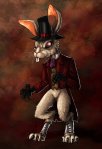
Miriam watched, amazed, as a white rabbit resolved from the gloom, complete with top hat and tails. The rabbit stood on his hind legs and nibbled at his front paws.
“How’s this?” The demon said. “You like my new form? You asked.”
“A rabbit?” Miriam could not keep the disdain out of her voice. “Of all the forms you can assume and you became a rabbit?”
“Well, not any rabbit,” said the demon, wiggling his rabbit ears. “I am a special rabbit. Let me grow a bit and I’ll show you.”
The figure of the rabbit stretched and filled out until it was almost seven feet tall. He was no longer cute but terrifying, and he towered over Miriam like an ominous cumulus cloud.
The demon rabbit smiled, revealing a mouth full of pointed teeth. They glittered like daggers in the light of the many candles Miriam had placed around the room. She noticed for the first time that his eyes were ruby red, like drops of blood.
“There now,” the demon said. “That’s better. I was feeling a little cramped. Now, what can I do to Mr. Brewer for you?”
“I don’t want you to do anything to him,” Miriam whispered. “I want you to make him notice me. You know, like take an interest in me, sort of. Do you understand?”
“Perfectly,” the demon said, rolling his eyes. “How intense do you want me to make him?”
“Oh, not too much. Not over the top,” Miriam replied. “Interested enough to flirt with me and so on.”
“Well, that’s easily done,” the demon said, smiling again, “But I need you to come and stand by me while I set this whole thing up.”
“You mean, come over there?” Miriam was incredulous. “No way I’m stepping out of this pentacle, demon. Not even if you go back to tiny rabbit size. I’m staying right here. You stay over there and do your thing and then we can both be on our way.”
“What, you don’t trust me?” the demon said in an aggrieved tone. “That is the height of rudeness.”
“Why should I trust you?” Miriam was adamant. “I don’t trust demons. All you do is destroy.”
“We say the same thing about humans.” The demon’s voice was no longer deep and resonant. Now it was low and sibilant. “At least, we don’t pretend to be nice while doing it.”
“All I wanted was a favor from you,” Miriam protested. “I meant no harm.”
“Never trust a demon,” the rabbit replied, stretching out its left hind paw. He deliberately brushed it across the floor, erasing part of the chalk line, opening a gap in the pentacle.

© Bryan Knower – January 2018

Fallen Angel – a flash fiction story

fallen angel 01

Fallen Angel

      Far away on Paradise’s horizon, an amber glow told Conah highlight was approaching. It was dark, although dark was relative here in the pearly glow that constituted lowlight. Conah’s eyes auto-adapted to the changing luminosity, catching the faint flash and sparkle of wings in the diffused light.
If you focused, he mused, you could make out the forms of other angels, flitting about on whatever purpose called them.
The heavens were full of the sparkling pinpoints, like fireflies at dusk on the Earth below. But fireflies existed on a different plane of existence, one that Conah could access at will until yesterday. Right now, he couldn’t join his kindred in flight because of a mistake he had made down on that other plane. A mistake resulting in his confinement here, in this garden without walls; an island here in Paradise. The garden had no tangible barriers, but he could not leave. His wings were bound so tight it felt like shards of glass were piercing his shoulders every time he forgot and tried to spread them.
He had not intended to do what he did. Assigned as an observer to a hospital on Earth, he was there to help the soul of a little girl transition from her ravaged body to the halls of Paradise’s first plane. The girl had terminal cancer and her time on Earth was ending. Conah could see she was suffering as she struggled to breathe, her fragile chest heaving with the effort of filling her collapsing lungs.
A nearby machine made strange rhythmic sounds as it breathed for the girl, making her eyelids appear to flutter in sync with the machine’s labors. Conah could not say why he did it, but materializing beside the laboring child he took her hand in his and breathed over her.
The girl’s eyes flew open and a smile lit her thin cracked lips as she saw Conah bending over her.
“Have you come to take me?” she said.
“No, little one,” he replied, placing his hand over her heart. “I have come to take away the thing that is destroying you.”
He leaned over and inhaled the breath from the girl’s mouth, exhaling a smoky cloud into the air around them. Pressing his mouth to hers he breathed into her, feeling his breath expand into her diseased airways, the tissue healing as he filled her with his essence. The girl’s eyes closed and she reached out to him. He took her hands in his and willed his spirit into her. As he concentrated, the girl’s pallor decreased and her face took on a rosy hue. Her body relaxed and she fell into a restful slumber. Conah placed her hands on her chest and leaned back to see Ruhiel standing on the other side of the hospital bed, shaking his head as he looked at him.
Conah stepped away from the sleeping girl and looked at his mentor. The concern in the ageless face and Ruhiel’s eyes told Conah the other knew what he had done.
“I’m not sorry,” he said. “Will you bring back her suffering?”
“No Conah, it’s too late for that,” Ruhiel said. “Neither you nor I can reverse what you have done here, but there will be consequences. You know that. For now, cloak yourself before you do any further damage.”
Conah realized that he was still materialized while Ruhiel was not. Any one of the dozens of people who attended on the child might walk in, compounding his offense. He re-assumed his non-corporeal form while Ruhiel made a series of strange gestures over the sleeping girl. The machines attached to her beeped and flashed, then settled down into a steady blinking rhythm.
“What did you do?” asked Conah, seeing the girl still breathing.
“She is still asleep, only deeper now, and she will not wake up,” Ruhiel said. “I cannot undo your action but I have tried to restore some of the balance you upset. The life you gave back to her she still has, but consciousness is far away and will remain so until her case is re-evaluated. But now,” he pointed upwards at the ceiling. “We have to go, Conah. I’m instructed to return with you. I’m sorry, but this is very bad. Not only for this poor soul but for you too. You knew the rules. Why?”
“She was suffering,” Conah said. The excuse was lame but he had no better answer to the question, even for himself. “I accept the consequences.”
“I know,” Ruhiel’s face was sad. “That’s what I’m afraid of. Time to go now, my friend.”
Retribution was swift. Shortly after his return, seven senior angels took Conah to a garden, and there, bound his wings with psychic spells. Conah knew they intended the binding to remind him of his offense at every discomforting turn. They left him there in lowlight’s seamless dusk, promising to return for him at next highlight. The implication was clear. His sentence was incomplete and Conah had an inking about what was coming.
He was not the first of his kind to make a similar mistake. It must be a flaw in angel makeup that caused angels to break this very rule so many times. The logical outcome was banishment to Earth for a human lifetime, something trivial by his own immortal lifespan. But he would be unable to communicate with others of his kind during that time, wouldn’t even be able to see and hear them. It was a far heavier burden than the pinioning of his wings.
Conah tried to contemplate the immensity of such a sentence and could not conceive it. No fellowship, no rhapsody, none of the glories of highlight or the subtle beauty of lowlight. He would not see his brothers and sisters unless they chose to reveal themselves to him, a forbidden action. He would fall behind his contemporaries along the sublimation path, returning a novice while they moved on to higher planes.
The only light at the end of his tunnel of misery was that his sentence was not permanent. There was no permanent sentence for an angel other than eternal banishment, and in all angelic history, only one had suffered that fate. He would return, diminished.
The susurration of many wings told him it was time. They had come for him. Around him, the seven elders materialized, their great pinions sweeping the air and folding into near invisibility as they took up positions around him. Geburatiel, the leader of the group spoke, his words shaping themselves inside Conah’s mind. Around him, he felt the agreement of the others.
“We have decided,” Geburatiel said. “Conah, you will return to Earth for a time to restore the balance you disturbed. You will exchange your immortal form for a human one and as a human, you will endure all mortal hopes and fears, losing all knowledge of your previous existence. This will prevail until you have redeemed yourself. Then, we will come for you, but, of the when and the where, you will have no knowledge or understanding.”
Conah felt numb, even though it was what he had been expecting. He bowed his head, even that small gesture sending stabbing pains through his shoulders. “When do I leave and who am I to be?” he asked.
“The who is not for you to know. The when is now,” Geburatiel said. “The ladder is ready. Come.”
Like a single entity, the seven elders surrounded Conah and he felt levitated amidst them as they rose as a group and departed the garden. Ahead, a rolling featureless plain ended in a bright line of light that was not the coming highlight. As they approached, Conah saw the head of an elaborate staircase looming at the edge of the plain. A radiance so bright that it washed out all visual perspective bathed the surrounding stairs. The stairs seemed to be floating in the light, disappearing down into it.
The group alighted at the head of the stairs and Geburatiel motioned for Conah to step forward.
Behind him, he felt a gentle push, although no-one actually touched him. He found himself on the first step as Geburatiel murmured something in his ear. A feeling of intense cold washed over him. It was an alien sensation in this place, at odds with the surrounding light and the warmth from the auras of the elder angels. Conah felt something falling away from him as if his garments were dissolving about him, though he wore none. Without any effort on his part, he found himself descending the stairs. The pain in his shoulders was gone. Around him, gossamer fragments materialized and disappeared. His wings were going too. Through the light, away from his kindred he descended, down into a soupy mist that seemed infused with sparkling dust motes. The feeling of downwardness disappeared as the luminescence around him thinned out. Below, he could discern features of a landscape.
He knew that landscape. He had left it with Ruhiel only the previous night. Disembodied and permeable, he drifted down towards a group of buildings set within manicured lawns. One building, in particular, seemed to be his destination. A feeling of dread came over him; a feeling outside his angelic experience; a mortal feeling.
The building was the very one from which Ruhiel had extracted him.
Unhindered, Conah slipped through the roof of the building, his permeable self sifting through the atoms and molecules of the building’s structure like water through a sieve. He passed through walls, floors, machinery and devices with the same ease as his entry into the building. Finally, he entered a room, feeling his form begin to coalesce. A bright stream of material from his core reached out like a tendril, extending towards a still form on a bed. Many machines connected to the figure and he knew her without having to look. It was the little girl he had wrenched back from destiny last night.
At last, he understood the irony of the balance the elders had spoken about. This was his doom then. To enter into this little girl, become her, endure her nothingness as the machines breathed and functioned for her until her cycle and his ran to completion. Only then would he be free again. Conah felt no regrets as he settled into the girl’s consciousness; became that consciousness. The infinite nothingness reached out to envelope him and Conah ceased to exist.

© Bryan Knower – May 2017

THE LAST GREENHOUSE IN THE WORLD

images

veryshortstories Gabriel looked with concern at the sapling in the corner. Its silver-gray leaves drooped and the plant, not more than four feet tall, projected an overall air of forlornness. Behind the ornate pot holding the plant the transparent panes of a wide bay window showed a murky red sky and rolling brown dunes denuded of vegetation, numbing in monotony. The dullness of the scene had no effect on Gabriel. His whole concern was focused on the plant before him.
Reaching out, he touched one of the leaves with his thumb and forefinger. It was the most delicate of touches but even that slight contact seemed too much for the sapling. It trembled and the leaf came away in his hand, leaving a stark white patch to mark the spot where it had detached from the trunk.
Gabriel inhaled sharply in dismay, examining the leaf in his hand. The top of the leaf was still a handsome silver gray but the underside showed mottled patches of brown and yellow and a spidery pattern of cracks covered the surface like a fine lattice. Even as he watched, the little tree seemed to sway, although no breeze stirred inside the building. Another of the lower leaves detached itself and floated down to join a small group of its fellows in the base of the pot.
Clutching the leaf in his hand Gabriel ran back up the long avenue leading back to his central office from this remote alcove on the edge of the building.
The office was hexagonal and glass-walled, providing a panoramic view of the interior of the building, which was large. From the central perspective, the six sides of the building were clearly evident, a macroscopic version of the office itself. Inside, machines and displays stood banked against the clear walls except for a small curtained alcove providing the only privacy in the entire building. The alcove contained Gabriel’s private quarters, although privacy never concerned him these days. Gabriel was the only occupant of the transparent building.
Hastily he dropped the leaf he was holding into the receptacle of a quietly humming machine and pressed some buttons. The leaf disappeared inside and the machine made quiet regular sounds as it analyzed its input. Less than a minute later a small screen popped up and data began to scroll down its surface. The receptacle popped open again but there was no sign of the leaf. Gabriel glanced quickly at the display and his shoulders sagged visibly.
Two days, he thought. That was all the time the sapling had left. The deterioration was irreversible and permanent. The tree was dying. Sadly he walked back out of the office and onto the wide plaza with its six broad avenues branching out precisely to the six sides of the building. Retracing his steps to the sapling, he stood looking at it, knowing he would have to take it out of the pot and destroy it before it infected any of the other plants nearby. But not yet. There were still two days and he could enjoy its company a little while longer.
Stepping to the clear wall, he pressed his face to the surface and looked outside. The building stood on a bare hilltop whose gentle slopes lead down to a shallow valley. The slopes were bare brown and dusty, the valley a continuation of the same. Beyond, other small hills rose up around him, similarly denuded and desolate, an endless procession stretching out into the distance. Gabriel knew that beyond the hills lay a great plain, equally dry and desolate, scoured by fierce winds that were gradually eroding the hills into dust. A world of perpetual dusk. He had not been outside in more than a century. There was nothing out there anymore. The machines that kept his building alive maintained him too, his circuits recharged and replenished as he rested in the nothing state he had come to call sleep.
But he never really slept. The term was a throwback to his long dead creators who had made him for a very specific purpose. He needed to stay vigilant. That was his imperative. He was the Keeper. The Keeper of the last greenhouse in the world.

© Bryan Knower 2015