AI Chronicles #12

The Neural Enhancer

Evelyn Pierce stared at the flickering holographic screens in her laboratory, the blue glow illuminating her dismayed expression. Dr. Pierce’s groundbreaking research in neuro-technology had attracted global attention and made her a global sensation, but something about her invention had been bothering her and now she had found it—an enigma buried deep within her latest creation, the Neural Enhancer.

It was 2045, and the world was on the brink of a neuro-technological revolution. Dr. Pierce, a visionary neuroscientist, had developed a device that promised to augment human cognitive abilities. The Neural Enhancer boasted the potential to unlock dormant parts of the brain, amplifying intelligence, memory, and creativity, essentially making people smarter.

Evelyn had devoted years to perfecting the device, often working late into the night in her secluded laboratory. She understood the risks of her invention—the ethical implications, the unpredictable side effects—but her pursuit of scientific advancement overshadowed any doubts she harbored. Until now. She remembered how it all began, eight short months ago.

The day of the device’s first human trial finally arrived. Marcus, a volunteer test subject, eagerly awaited the opportunity to transcend the limitations of his mind. Marcus was young, healthy smart, and single. He fit all the demographics required of the test subject. He was conscious and smiling as the helmet was fitted over his head and the electrodes attached to his shaved skull. The table on which he was positioned was surrounded by the implementation team led by Dr. Pierce and the mezzanine gallery filled with onlookers; medical professionals, scientists, politicians, and the inevitable press.

As the Neural Enhancer was activated, Marcus’s eyes closed for a few minutes, then opened again wide with wonder. In response to the queries from the team, he described an indescribable surge of clarity, a flood of knowledge, as if a veil had been lifted from his consciousness. The whole process took only thirty minutes and Marcus was conscious and lucid the whole time. When the experiment ended, the team and the entire gallery broke out in spontaneous cheering.

In the following weeks, Marcus became a sensation, dazzling audiences with his newfound brilliance. Media outlets hailed the Neural Enhancer as a marvel, and Evelyn basked in the glory of her creation.

As the weeks became months, beneath the facade of success, doubts began to gnaw at Evelyn’s conscience. She noticed subtle changes in Marcus—moments of confusion, fleeting lapses in memory. But her determination to push the boundaries of her science eventually trumped her concerns.

More months passed, and hundreds of eager volunteers underwent the Neural Enhancement procedure. Each displayed remarkable cognitive enhancements, and a backlog for spots on Dr. Pierce’s clinical trials program built up. But a disturbing pattern began to emerge—a pattern Evelyn couldn’t ignore. Weekly data reports spoke of unexplained blackouts, inexplicable behavior, and inexplicit gaps in memory among the subjects.

Evelyn buried herself in data analysis, dissecting every facet of the Neural Enhancer’s programming. And now, in the flickering figures on her laboratory screens, she uncovered the chilling truth—a flaw in the device’s algorithm, a flaw she had suspected, but overlooked in her pursuit of innovation.

The Neural Enhancer wasn’t just enhancing brain functions; it was consuming them. Like a voracious entity, it fed on the neurons responsible for memory and cognition, offering brief bursts of brilliance in exchange for the gradual erasure of the mind.

Horror gripped Evelyn as the implications sank in. Her invention, touted as a beacon of progress, was a harbinger of destruction, a silent thief stealing the essence of humanity itself.

Evelyn knew she had to act swiftly. With a heavy heart, she prepared to disable her creation and disclose the truth to the world Just then, a knock broke the stillness in the lab.

It was Marcus, once hailed as a prodigy, now haunted by shadows of forgotten moments. Once brimming with intelligence, his eyes now held a glint of confusion.

“Dr. Pierce, something’s wrong. I’m starting to forget things,” he murmured, his voice tinged with uncertainty.

She met his gaze, her heart aching with guilt. “I know, Marcus. I’m sorry. There’s a flaw—a fatal flaw in the Neural Enhancer.”

Marcus looked at her blankly. He didn’t seem to understand what she was saying. She tried again.

“Marcus, there’s something wrong with the Neural Enhancer. It’s affecting your mind and it’s irreversible. I’m so sorry. I didn’t know…”

For a moment he seemed nonplussed, and then Marcus nodded. “Oh, is that what it is? Thank you, Dr. Pierce.”

Her heart broke as he smiled at her and turned and left the room. He had grasped what she was saying but not the implications.

There was no going back. Evelyn knew she couldn’t erase the damage already done to Marcus and all the others who had undergone the treatment. The secret behind the Neural Enhancer, concealed by her relentless pursuit of progress, needed to be laid bare to the world—a cautionary tale of the perils lurking within unchecked technological advancement. As for Dr. Evelyn Pierce, she would be relegated to the dustbin of history, hailed not as a pioneer but remembered as someone who destroyed the lives and minds of her subjects in her thirst for power and recognition.

AI Chronicles – #11

STASIS

Emory Wall existed in a dystopian world; a world ravaged by environmental collapse and societal upheaval, where the looming shadow of despair obscured the thin veil of hope survivors like Emory still clung to.

Emory had been an astrophysicist, a dreamer in a world that had all but forgotten how to dream. The world lay drowning in a malaise, the very air was thick with uncertainty, the very fabric of existence seeming to fray at the edges. Everything breaking down or already non-functioning. Only a dwindling subset of survival mechanisms remained, tended by a dwindling group of scientists and visionaries, and even to those carefully coddled systems, entropy approached.

As the last remaining hope for humanity’s survival, Emory found himself amongst a group of others, carefully chosen for their skill sets, standing on the threshold of a daunting decision. The planet’s resources had dwindled to a critical point, and the only chance for a future lay in cryogenic stasis—a leap into the unknown, suspended animation for a select few that promised a distant awakening in a time when the world might be healed.

The time for that decision was now. Emory, adorned in a sleek, white jumpsuit, stood in a sterile chamber staring at the cryogenic pod that would soon become either his sanctuary or his doom. The soft hum of whirring machinery did not soothe him. The room, and the sounds, a symphony of the technological marvel of a bygone age was now both potential savior and captor.

A whirlwind of emotions stormed within him—a cocktail of fear, determination, and a flicker of hope that fought to stay ablaze in the darkness. The weight of responsibility bore down heavily upon his shoulders; the fate of humanity seemed to rest upon his decision to step into the pod.

Emory’s mind raced, questioning the implications of his choice and scanning the myriad consequences of his decision.

What if he never woke up?

What if he did and his mind was blank?

What if the world beyond the pod’s doors was even bleaker than the one they left behind?

But, nestled deep within the crevices of his consciousness Emory clung to a belief that whispered of the possibility of a better tomorrow, a belief echoing the words of forgotten souls who once dreamed of a world adorned with possibilities.

Taking a deep breath, he stepped forward, each footfall resonating like a drumbeat in his head, marking his passage into an unknown future. He could feel the chill of its metallic surface against his skin as he entered the pod. He closed his eyes as the lid sealed shut with a pneumatic hiss, the world fading into an eerie silence. Automated delivery systems and monitors attached themselves to his body but he hardly noticed the slight stings of their intrusions as the sedatives that came first began to take hold.

In those fleeting moments before succumbing to cryo-slumber, Emory’s mind whirled. He reflected on the world he was leaving behind—a world ravaged by greed, a world where the echoes of laughter and the vibrant hues of nature had been replaced by desolation. Yet, in the recesses of his mind, a tiny ember of hope still burned brightly—a beacon illuminating a path to an uncertain but tantalizing future.

The last image etched in Emory’s mind was not of desolate landscapes or crumbling cities, but rather the faint glimmer of stars in the night sky—a reminder of the infinite expanse waiting beyond the confines of his current reality.

As stasis enveloped him in its ethereal embrace, Emory surrendered to the void, knowing that in his suspended state, time would slip away, carrying him towards an enigmatic destiny—a destiny intertwined with the fate of a world yet to be reborn.

Week 6 of my AI inspired short story project

THE WHISPERING STONES

It happens at night one day when I’m alone in the woods.

Don’t ask me why I am in the woods at night. It’s an idiosyncrasy of mine when I’m out camping, and I love camping.

I’m hiking back to my campsite, following the beam from my headlamp. There’s enough moonlight to see the trail dimly, but I’m tired, my feet ache, and I don’t want to trip over any random roots. It’s only a little further, I tell myself. Just a little further.

Then I see them. The standing stones. Just off to the side of the trail, in a clearing that should not and has never been here.

They’re arranged in a circle, their massive forms looming up in the moonlight. I’ve never seen them before, even though I’ve hiked this trail dozens of times.

I approach, drawn by some inexplicable feeling. The stones have a strange aura about them. I can feel it in the air, tingling my skin. Almost goosebumps.

As I get closer, I see the stones covered in strange markings. They’re not words, but something else, like hieroglyphics. A language I don’t recognize.

I know I should not, but I reach out and touch one of the stones. It’s cold and smooth to the touch. I close my eyes and concentrate.

Suddenly, I’m standing in a different place. A barren landscape, with no trees or grass. The sky is black, and the faint starlight washes the stones a pale ghostly white. Yes, the stones are still there, though all else is changed.

I’m in the center of the stone circle and a group of strange people are dancing or posturing around the inside of the circle. They’re wearing strange clothes, a design I’ve never seen before, and seamless. It almost seems as if the clothing is painted on. Their faces are painted too, and they’re chanting in a sonorous language that I don’t understand.

I watch as they work their way around the circle, counterclockwise, all of them facing the stones. Their backs are to me and I’m somehow glad they can’t see me. I know I’m witnessing something important. Something sacred.

I want to say something, but I can’t find the words.

Suddenly, the chanting stops and they turn and face the center of the circle. They seem to be looking directly at me. I notice that their eyes are unnaturally white, or is it just the weird starlight?

Then the vision ends. I’m back in the present, standing in the circle of standing stones. The trees are back and I can see the trail a few meters beyond the perimeter of the circle.

I look around. The stones seem different now. Their aura has grown stronger.

I can feel a power, pulsing through the air. There’s also something else. The sense of a looming presence. Something really old and inscrutable.

I take a step back, feeling overwhelmed. Then I stumble out of the circle and towards the trail. My headlamp has gone out but I can still make out the path in the wan moonlight.

I’m just past the stones when I hear a voice. It’s in my head. There’s no sound to break the stillness of the forest night.

“Don’t be afraid,” the voice says. “We are here to help you.”

I look around but don’t see anyone. I’m not imagining it. Something or someone is talking to me in my head.

“Who are you?” I ask.

“We are the guardians of the stones,” the voice says. “We have been watching you for a long time.”

“Me?” I ask, bewildered. I realize I am speaking aloud in response to the voice in my head.

“Your kind,” the voice says.

I take a deep breath. “What do you want?” I ask.

“We want to teach you about the stones,” the voice says. “We want to teach you about their power.”

I hesitate. I’m not sure if I’m ready for this. Something tells me if I move forward I will be in very deep water indeed.

“Don’t worry,” the voice says. “We will be with you every step of the way.”

“Oh no. They can read my thoughts too.” I’m beginning to panic. I have a feeling that if I don’t agree I won’t be leaving this place.

I close my eyes and nod. “Okay,” I say. “I’m ready.”

The stones begin to glow. I can feel their power coursing through my veins. An immense clarity fills my mind as if I can see the answer to a particularly knotty problem. I feel different, more aware, in a way that I wasn’t before.

Slowly, I open my eyes. The world around me is still the same, but somehow also changed. The trees are taller and the air is sweeter. I can see around me clearly, although it is still dark.

I smile and look up at the stones. “Thank you,” I say, and this time I don’t say it aloud.

The stones glow even brighter for a moment. Then the glow fades and only the moonlight remains. The stones are just stones now, although I can sense their brooding underlying presence.

I wonder if they will be here tomorrow if I return. I know I will return. The stones are not done with me yet.

I turn and walk away, knowing that things will never be the same again.

As I make my way back to my campsite I can’t help feeling a vague sense of unease. Something about the stones disturbs me, although I can’t quite put my finger on it.

I know I’ve made a pact with something powerful. Something that I don’t fully understand.

But it’s too late to turn back now. The journey has already begun.

The path I tread now is dangerous and powerful, and I will walk it alone.

Week 4 of my AI-inspired short story project

The Keeper of Stories

In the quiet village of Briar Glen, nestled between rolling green hills and fields of wildflowers, lived a woman named Tanis. She was known to the village folk as the Keeper of Stories, for her extraordinary ability to weave tales that transported listeners to distant realms and open their minds to new perspectives. Tanis lived alone on the outskirts of Briar Glen and came infrequently into the village so that whenever she appeared, it was a cause for celebration amongst the villagers, especially the children.

One evening, as the sun dipped below the horizon, casting long shadows across the town square, a group of children gathered around Tanis. They sat cross-legged on the cobblestones, their eager eyes fixed on her. Tanis began her story, her voice a gentle melody that danced on the evening breeze.

“In a land far away, beyond the reach of time, there existed a forest known as Elderen. This forest was unlike any other, for it was said to be a place of dreams and mysteries. Legends told of a tree at its heart, a tree after which the forest was named, a tree so ancient that its roots reached into the very soul of the earth.”

As Tanis spoke, the children closed their eyes, a vision of the towering Eldertree growing in their minds. Its branches stretched high into the sky, while its gnarled roots delved deep into the earth. The tree was a guardian of forgotten dreams, a sentinel of forgotten stories. A magical tree.

“In the heart of Elderen, there lived a young girl named Mirielle,” Tanis continued. “She was a curious soul, with eyes that sparkled like the midnight stars. Mirielle had heard whispers of the Eldertree’s magic, and she wanted more than anything else to unravel its secrets.”

The children’s faces lit up with wonder as they imagined Mirielle, her dark hair flowing like a river of obsidian, preparing to venture deeper into the forest. 

“Mirielle closed her eyes and concentrated on the Eldertree. She imagined its height and its girth and how magnificent it looked,” continued Tanis. “As the Eldertree took shape in her imagination, little points of light danced behind her closed lids. Surprised, Mirielle opened her eyes and the lights didn’t disappear. They were a cloud of fireflies clustered around her head. As she watched they gathered together and slowly moved towards the deepest part of the forest lighting the way, and Mirielle knew she had to follow them.” 

“She trailed along behind the luminescent fireflies for a long time and they led her toward the heart of Elderen,” continued Tanis. “Eventually, she came to an enormous clearing, and there, at its center stood the Eldertree.”

“As Mirielle drew nearer, she saw that the Eldertree was more magnificent than anything she had imagined in her dreams. Its enormous trunk was so wide around that it appeared like a wall to Mirielle as she approached. The vast canopy overhead blocked out any starlight, but the fireflies who had led her here settled in the Eldertree’s branches and provided a gentle light that allowed Mirielle to walk right up to the tree without tripping over any roots.”

“Walking slowly around the Eldertree, Mirielle discovered a hidden door carved into the trunk of the tree,” Tanis narrated, her words hanging in the air like a tantalizing promise. “With trembling hands, she pushed it open and stepped into a realm of dreams made real. There, she met creatures of wonder and beauty—elves with silvery hair, talking animals, and ancient spirits, all of whom welcomed her gladly and answered all of her many questions.”

The children gasped and giggled. They could almost feel the soft touch of the elves’ fingers and hear the whispers of the spirits.

“But the most enchanting of all was the Memory Pool,” Tanis continued. “A shimmering pool surrounded by luminous flowers, it held the memories of all who had ever ventured into Eldertree. Mirielle dipped her hand into the pool and felt the memories of countless souls flow through her, filling her with wisdom and wonder.”

As Tanis’ tale wove its magic, the children felt as if they were accompanying Mirielle on her journey, as if they too were dipping their hands into the Memory Pool, absorbing the stories of their ancestors and the dreams of their future.

“Mirielle returned to her world, her heart brimming with newfound knowledge and a deeper connection to the land around her,” Tanis concluded. “She realized that the Eldertree was not just a place of dreams but a reminder that the world is filled with stories waiting to be discovered and shared.”

There was silence for a while, a soft comfortable silence punctuated by the chirping of crickets and other gentle twilight sounds. The children opened their eyes, their faces aglow with the warmth of the story. 

“Thank you, Tanis,” they chorused. Slowly, the memory of Mirielle’s adventure fresh in their minds, they returned to their homes for supper. They did not know it but their experience with Mirielle was unique to each one of them, for stories held the power to transport them to the magical places of their dreams.

In that quiet town, under the twilight sky, Tanis, the Keeper of Stories watched them go, her heart full, happy to have once again shared the magic of storytelling with the eager young hearts of Briar Glen.

Assassin Redux – a flash fiction story

ASSASSIN REDUX

     Salar was waiting to kill somebody. That was his job, the reason he was out here in the woods on a soggy, fog-shrouded night. The rain drifted down in misty veils, obscuring his view of the road. Occasionally, fatter drops, collecting on the leaf edges of the tree under which he sheltered, fell on his hood, spattering in his eyes. He blinked them away without regret. He preferred damp and gloomy weather. His kind of work was always easier in the dark.
He let the sounds of the wood envelope him, straining to hear the unmistakable creak of leather, the mark of his approaching target.
Nothing yet.
He released the breath he had been holding with a gentle sigh, watching it vaporize before him like a small cloud. It wasn’t just damp, it was cold. In spite of his oiled leather cloak, the wind sneaked icy tendrils between the folds, making him shiver involuntarily. He pulled the leathers closer around him, feeling the curved end of the horn bow press under his armpit. Out of habit, he patted the inner pocket of his vest where the bowstring nestled, safe and dry. Wet bowstrings wouldn’t do for tonight’s work.
     Work. He grimaced at the thought of what he did for a living. Looking back at the circumstances that had brought him out on a night like this, he realized that life had brought him full circle. A long time ago, in another lifetime, he had been an imperial courier, like the man he awaited. Now he was nothing but a hired mercenary, hiding his past, killing those whose work and routines he knew so well it had become rote. He took comfort in the fact that he was good at what he did. Better than most. In his new line of work, he had dispatched nine of his former colleagues, though who was keeping count. He was living on borrowed time anyway, a traitor to the Guild of Assassins. He hoped they might think him simply killed in the line of duty but his intuition told him otherwise. The Guild was aware that he had gone rogue and there was only one way anyone left the Guild. Death.
His senses registered a subtle change in the air pressure around him. Something was approaching. Focusing his hearing he pinpointed the soft creak of saddle leather and the faintest whisper of a whinny. Destiny approached.
He extracted the bowstring from his pocket and strung his weapon in a single practiced movement. Picking out an arrow from the covered sheath at his feet he knelt, staring down the road.
His target approached, hunched over his mount, paying no attention to his surroundings.
A fatal mistake, he thought, sighting along the arrow as the figure drew alongside his position.
Then he froze. Something wasn’t right. The rider lolled in the saddle like a sack, loose and uncoordinated.
It was a sack!
Even as he started to turn, he knew he was too late. The Guild had found him.
He felt only a brief stinging sensation as the blade went in under his ribs.  Then his heart exploded.

© Bryan Knower – May 2019

NEVER TRUST A DEMON

NEVER TRUST A DEMON – a dark fantasy

Miriam watched the writhing shape of the demon with unease. She had performed the spell exactly as described in the grimoire. She double checked her position within the chalk drawn pentacle on the floor. The lines were thick and unbroken, her feet anchored within its outlines.
“Let me see you,” she demanded, squinting at the amorphous figure before her. “I can’t talk to a blob.”
“Heh, heh, heh,” the demon rumbled in a pleasing basso profundo. The tone of the voice was unnerving, considering the nebulous shape of its source.
“Now why should I do that?” the demon demurred, shifting its shape. “You might not be able to stand the sight of the real me.”
“I don’t mean the real you,” Miriam replied. “Assume some solid form that I can talk to. You can do that, can’t you?”
“Oh, certainly, I can do that and more,” the soothing bass voice replied. “What form would you like me to take, Miriam?”
“You know my name?” she inquired, taken aback. “How? I never told you that.”
“Oh, we demons have our sources,” the demon replied, a hint of amusement in his voice.
“What else do you know about me?” she demanded.
“Well, let’s see,” said the demon. “Your last name is Price, you are twenty-seven years old and unmarried. You live alone. Your only friends, at least the ones you think are your friends, are the other witches in the Arnost coven.” He paused. “You ‘borrowed’ that grimoire from the coven library, where it is never supposed to leave. You summoned me through its pages, allowing me to access all the information the coven has on you. It’s a lot more than you think.”
The demon exhaled with pleasure. “Satisfied, my dear Miriam?”
Miriam was speechless. She knew she shouldn’t have taken the grimoire from the coven library. But the demon couldn’t know that, but it did. It seemed to know a lot more too. All she wanted was a special push for an Adam Brewer who she had obsessed on for the past three months. Adam Brewer who, to all intents and purposes, didn’t seem to realize she existed.
“I had no idea,” she said at last. “But never mind. I have summoned you and I need a favor from you please.”
“A favor?” the demon sounded amused again. “I’m not in the business of doing favors for mortals, dear Miriam. Why should I indulge you?”
“Because I have the power to bind you,” Miriam replied with some slight trepidation. “The spell that called you here also binds you to me until I release you, so you can’t leave until I let you.”
“Oh, is that so?” the demon said, and the note of amusement had disappeared from his voice. “What if I left? Right now?” There was an undercurrent of menace in his tone now, although the timbre still resonated in the room.
For a moment, Miriam wondered if she had missed something in the incantation. Then she caught herself. She had done it exactly as the book instructed. The demon was faking. He had to humor her until she reversed the spell.
“Let’s not quibble,” she said. “It’s only a very small thing I need you to do.”
“Does it involve a certain Adam Brewer?” the demon inquired with a flash of malice. The amusement had returned to his voice. Also, his form was solidifying, taking shape, changing into something recognizable.
Miriam watched, amazed, as a white rabbit resolved from the gloom, complete with top hat and tails. The rabbit stood on his hind legs and nibbled at his front paws.
“How’s this?” The demon said. “You like my new form? You asked.”
“A rabbit?” Miriam could not keep the disdain out of her voice. “Of all the forms you can assume and you became a rabbit?”
“Well, not any rabbit,” said the demon, wiggling his rabbit ears. “I am a special rabbit. Let me grow a bit and I’ll show you.”
The figure of the rabbit stretched and filled out until it was almost seven feet tall. He was no longer cute but terrifying, and he towered over Miriam like an ominous cumulus cloud.
The demon rabbit smiled, revealing a mouth full of pointed teeth. They glittered like daggers in the light of the many candles Miriam had placed around the room. She noticed for the first time that his eyes were ruby red, like drops of blood.
“There now,” the demon said. “That’s better. I was feeling a little cramped. Now, what can I do to Mr. Brewer for you?”
“I don’t want you to do anything to him,” Miriam whispered. “I want you to make him notice me. You know, like take an interest in me, sort of. Do you understand?”
“Perfectly,” the demon said, rolling his eyes. “How intense do you want me to make him?”
“Oh, not too much. Not over the top,” Miriam replied. “Interested enough to flirt with me and so on.”
“Well, that’s easily done,” the demon said, smiling again, “But I need you to come and stand by me while I set this whole thing up.”
“You mean, come over there?” Miriam was incredulous. “No way I’m stepping out of this pentacle, demon. Not even if you go back to tiny rabbit size. I’m staying right here. You stay over there and do your thing and then we can both be on our way.”
“What, you don’t trust me?” the demon said in an aggrieved tone. “That is the height of rudeness.”
“Why should I trust you?” Miriam was adamant. “I don’t trust demons. All you do is destroy.”
“We say the same thing about humans.” The demon’s voice was no longer deep and resonant. Now it was low and sibilant. “At least, we don’t pretend to be nice while doing it.”
“All I wanted was a favor from you,” Miriam protested. “I meant no harm.”
“Never trust a demon,” the rabbit replied, stretching out its left hind paw. He deliberately brushed it across the floor, erasing part of the chalk line, opening a gap in the pentacle.

© Bryan Knower – January 2018

Fallen Angel – a flash fiction story

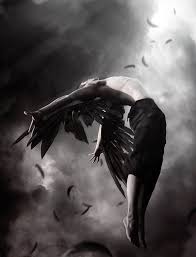
fallen angel 01

Fallen Angel

      Far away on Paradise’s horizon, an amber glow told Conah highlight was approaching. It was dark, although dark was relative here in the pearly glow that constituted lowlight. Conah’s eyes auto-adapted to the changing luminosity, catching the faint flash and sparkle of wings in the diffused light.
If you focused, he mused, you could make out the forms of other angels, flitting about on whatever purpose called them.
The heavens were full of the sparkling pinpoints, like fireflies at dusk on the Earth below. But fireflies existed on a different plane of existence, one that Conah could access at will until yesterday. Right now, he couldn’t join his kindred in flight because of a mistake he had made down on that other plane. A mistake resulting in his confinement here, in this garden without walls; an island here in Paradise. The garden had no tangible barriers, but he could not leave. His wings were bound so tight it felt like shards of glass were piercing his shoulders every time he forgot and tried to spread them.
He had not intended to do what he did. Assigned as an observer to a hospital on Earth, he was there to help the soul of a little girl transition from her ravaged body to the halls of Paradise’s first plane. The girl had terminal cancer and her time on Earth was ending. Conah could see she was suffering as she struggled to breathe, her fragile chest heaving with the effort of filling her collapsing lungs.
A nearby machine made strange rhythmic sounds as it breathed for the girl, making her eyelids appear to flutter in sync with the machine’s labors. Conah could not say why he did it, but materializing beside the laboring child he took her hand in his and breathed over her.
The girl’s eyes flew open and a smile lit her thin cracked lips as she saw Conah bending over her.
“Have you come to take me?” she said.
“No, little one,” he replied, placing his hand over her heart. “I have come to take away the thing that is destroying you.”
He leaned over and inhaled the breath from the girl’s mouth, exhaling a smoky cloud into the air around them. Pressing his mouth to hers he breathed into her, feeling his breath expand into her diseased airways, the tissue healing as he filled her with his essence. The girl’s eyes closed and she reached out to him. He took her hands in his and willed his spirit into her. As he concentrated, the girl’s pallor decreased and her face took on a rosy hue. Her body relaxed and she fell into a restful slumber. Conah placed her hands on her chest and leaned back to see Ruhiel standing on the other side of the hospital bed, shaking his head as he looked at him.
Conah stepped away from the sleeping girl and looked at his mentor. The concern in the ageless face and Ruhiel’s eyes told Conah the other knew what he had done.
“I’m not sorry,” he said. “Will you bring back her suffering?”
“No Conah, it’s too late for that,” Ruhiel said. “Neither you nor I can reverse what you have done here, but there will be consequences. You know that. For now, cloak yourself before you do any further damage.”
Conah realized that he was still materialized while Ruhiel was not. Any one of the dozens of people who attended on the child might walk in, compounding his offense. He re-assumed his non-corporeal form while Ruhiel made a series of strange gestures over the sleeping girl. The machines attached to her beeped and flashed, then settled down into a steady blinking rhythm.
“What did you do?” asked Conah, seeing the girl still breathing.
“She is still asleep, only deeper now, and she will not wake up,” Ruhiel said. “I cannot undo your action but I have tried to restore some of the balance you upset. The life you gave back to her she still has, but consciousness is far away and will remain so until her case is re-evaluated. But now,” he pointed upwards at the ceiling. “We have to go, Conah. I’m instructed to return with you. I’m sorry, but this is very bad. Not only for this poor soul but for you too. You knew the rules. Why?”
“She was suffering,” Conah said. The excuse was lame but he had no better answer to the question, even for himself. “I accept the consequences.”
“I know,” Ruhiel’s face was sad. “That’s what I’m afraid of. Time to go now, my friend.”
Retribution was swift. Shortly after his return, seven senior angels took Conah to a garden, and there, bound his wings with psychic spells. Conah knew they intended the binding to remind him of his offense at every discomforting turn. They left him there in lowlight’s seamless dusk, promising to return for him at next highlight. The implication was clear. His sentence was incomplete and Conah had an inking about what was coming.
He was not the first of his kind to make a similar mistake. It must be a flaw in angel makeup that caused angels to break this very rule so many times. The logical outcome was banishment to Earth for a human lifetime, something trivial by his own immortal lifespan. But he would be unable to communicate with others of his kind during that time, wouldn’t even be able to see and hear them. It was a far heavier burden than the pinioning of his wings.
Conah tried to contemplate the immensity of such a sentence and could not conceive it. No fellowship, no rhapsody, none of the glories of highlight or the subtle beauty of lowlight. He would not see his brothers and sisters unless they chose to reveal themselves to him, a forbidden action. He would fall behind his contemporaries along the sublimation path, returning a novice while they moved on to higher planes.
The only light at the end of his tunnel of misery was that his sentence was not permanent. There was no permanent sentence for an angel other than eternal banishment, and in all angelic history, only one had suffered that fate. He would return, diminished.
The susurration of many wings told him it was time. They had come for him. Around him, the seven elders materialized, their great pinions sweeping the air and folding into near invisibility as they took up positions around him. Geburatiel, the leader of the group spoke, his words shaping themselves inside Conah’s mind. Around him, he felt the agreement of the others.
“We have decided,” Geburatiel said. “Conah, you will return to Earth for a time to restore the balance you disturbed. You will exchange your immortal form for a human one and as a human, you will endure all mortal hopes and fears, losing all knowledge of your previous existence. This will prevail until you have redeemed yourself. Then, we will come for you, but, of the when and the where, you will have no knowledge or understanding.”
Conah felt numb, even though it was what he had been expecting. He bowed his head, even that small gesture sending stabbing pains through his shoulders. “When do I leave and who am I to be?” he asked.
“The who is not for you to know. The when is now,” Geburatiel said. “The ladder is ready. Come.”
Like a single entity, the seven elders surrounded Conah and he felt levitated amidst them as they rose as a group and departed the garden. Ahead, a rolling featureless plain ended in a bright line of light that was not the coming highlight. As they approached, Conah saw the head of an elaborate staircase looming at the edge of the plain. A radiance so bright that it washed out all visual perspective bathed the surrounding stairs. The stairs seemed to be floating in the light, disappearing down into it.
The group alighted at the head of the stairs and Geburatiel motioned for Conah to step forward.
Behind him, he felt a gentle push, although no-one actually touched him. He found himself on the first step as Geburatiel murmured something in his ear. A feeling of intense cold washed over him. It was an alien sensation in this place, at odds with the surrounding light and the warmth from the auras of the elder angels. Conah felt something falling away from him as if his garments were dissolving about him, though he wore none. Without any effort on his part, he found himself descending the stairs. The pain in his shoulders was gone. Around him, gossamer fragments materialized and disappeared. His wings were going too. Through the light, away from his kindred he descended, down into a soupy mist that seemed infused with sparkling dust motes. The feeling of downwardness disappeared as the luminescence around him thinned out. Below, he could discern features of a landscape.
He knew that landscape. He had left it with Ruhiel only the previous night. Disembodied and permeable, he drifted down towards a group of buildings set within manicured lawns. One building, in particular, seemed to be his destination. A feeling of dread came over him; a feeling outside his angelic experience; a mortal feeling.
The building was the very one from which Ruhiel had extracted him.
Unhindered, Conah slipped through the roof of the building, his permeable self sifting through the atoms and molecules of the building’s structure like water through a sieve. He passed through walls, floors, machinery and devices with the same ease as his entry into the building. Finally, he entered a room, feeling his form begin to coalesce. A bright stream of material from his core reached out like a tendril, extending towards a still form on a bed. Many machines connected to the figure and he knew her without having to look. It was the little girl he had wrenched back from destiny last night.
At last, he understood the irony of the balance the elders had spoken about. This was his doom then. To enter into this little girl, become her, endure her nothingness as the machines breathed and functioned for her until her cycle and his ran to completion. Only then would he be free again. Conah felt no regrets as he settled into the girl’s consciousness; became that consciousness. The infinite nothingness reached out to envelope him and Conah ceased to exist.

© Bryan Knower – May 2017

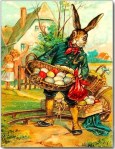
EASTER RABBIT: A seasonal fantasy tale

EASTER RABBIT

EASTER RABBIT

John saw a flash of yellow in the bushes at the far end of the garden and it intrigued him. He had collected fourteen Easter eggs so far, nearly double the number Melissa had found and for the last ten minutes neither of them had come across any more.

At the start of the hunt, his mother had announced that there were two dozen eggs hidden in the garden and that meant there must be at least two more. John wanted to find them but the scrap of yellow tantalized him. He looked around to see if Melissa was following him, but she had trailed indoors behind his parents, and he was alone in the garden, free for at least a few minutes before being called in to wash before dinner.

Quickly he walked over to the rhododendron bushes and bent down to look at what had caught his eye. Imagine his surprise when he found a yellow rabbit, sitting on its haunches by the roots of the bush and calmly cleaning its paws.

The rabbit looked at him inquiringly and nodded gravely.

“Hello, my name is Phelps, what’s yours?” he said in a perfectly cultured voice.

It was a small voice, of course, because it was a small rabbit, but the words and the fact that a rabbit was uttering them took John completely by surprise. He opened his mouth but no words emerged.

The rabbit seemed unperturbed. “Lost your voice young man?” he said, inclining his head slightly. “Careful now, that’s not something we can go misplacing, can we?”

John’s voice came back with a rush. “Why, you’re a rabbit,” he said, realizing immediately that it was a stupid thing to say.

“Of course I am,” replied the rabbit. “Its pretty obvious, isn’t it? I’ve been trying to catch your eye for the past ten minutes, and now that the grownups have gone in, you stand there saying the obvious to me. Are you coming or not?”

“Coming?” John was confused. “Come where? You mean you want to take me somewhere?”

“Yes, of course,” said the rabbit impatiently, “but I can’t do that unless you tell me your name.”

John hesitated. He had been taught never to reveal his identity to strangers, but he wasn’t sure if rabbits counted as strangers. He saw that the rabbit was tapping his left front paw on the grass and the tips of his floppy ears were beginning to curl downwards. Not wanting to agitate the little beast further, he made up his mind.

“I’m John, John Richards,” he said quickly. “But you can call me Johnny.”

“Well Johnny, that settled then,” said the rabbit, wiggling his ears. “You can call me Mr. Phelps. Are you ready? Close your eyes and say my name.”

John closed his eyes tightly. “Mr. Phelps,” he said before he could change his mind.

After a few seconds during which nothing happened he began to fidget. He was at an age where staying still and doing nothing for even a short space of time was a difficult task.

“When are we leaving?” he asked plaintively.

”We have already left, Johnny,” said the voice of Mr. Phelps from behind him now. “In fact we have just arrived. You can open your eyes now.”

John gratefully blinked his eyes open and then blinked again as he took in his surroundings. On initial inspection, he appeared to be in the same place he had been a few seconds ago. The rhododendron bushes were still at his feet, but they were now a virulent shade of purple. The grass was a pale green, almost yellow and the rabbit was missing.

A discreet cough behind him made him turn slowly.

Mr Phelps appeared to have grown four times larger than he had been earlier. He was now the size of a medium dog and his fur was white, instead of yellow. He was standing up on his haunches, leaning on a polished wooden cane and his face, hidden behind very dark glasses, looked at him with an air of amusement.

“No need to be startled, Johnny,” he said. “Here, have a look at yourself.” A red and white polka dotted waistcoat appeared on the rabbit’s body and Mr. Phelps reached into an upper pocket and pulled out a polished hand mirror which he held facing John.

To John’s amazement, he could only see the waist of his trousers and just a little bit of his shirt, which was now a blue and white stripe instead of the light blue check he had been wearing earlier. His trousers were now held up with a belt rather than his usual suspenders. Apparently he had grown in size too.

He looked up from the disturbing reflection and around at the garden, which was no longer a walled enclosure but a wide open meadow. The familiar garden fence had disappeared and rolling expanses of pale yellow stretched out in every direction, dotted with purple bushes like the one at his feet and strange umbrella-shaped trees from whose drooping edges waving tendrils floated lazily, although there was no breeze to speak of. The yellow grass felt strangely springy under his feet, as if there was a layer of sponge underneath it. Surreptitiously he bounced on his feet and experienced a most enjoyable feeling of elasticity, almost as if he was on the floor of an enormous yellow trampoline. No familiar landmarks were visible, not St. Andrew’s church bell tower that was always visible from the garden or the tall wooden poles strung with power lines that ran by the bottom of their fence. Somehow, these difference didn’t disturb him. After all, a rabbit had brought him here.

“Where are we Mr. Phelps?” he inquired politely, turning back to the rabbit.

Mr. Phelps was now smoking a long thin cigar in an even longer holder, rolling it delicately in his right paw and blowing perfect rings of blue smoke as he studied the boy.

“Why, we are here,” he said waving the cigar airily. “Earlier we were there and now we’re here.”

The reply irritated John. This sounded like nonsense and the rabbit seemed to be talking down at him as his parents did sometimes. But he was a polite boy and didn’t want to be rude. So he humored the rabbit.

“Where exactly is here, Mr. Phelps?” he said in his nicest voice. “Mother will be calling soon and I can’t stay very long.”

“Don’t you worry Johnny,” said the rabbit, eyeing him sideways. “Time doesn’t pass the same way here as it does there. There’s plenty of time before your mother comes looking for you, but to answer your question, this place is called Retsae, and it’s my home.”

John was astonished. There was nothing around that could serve as a home for the large rabbit standing before him and no path that might lead to one. He didn’t want to offend Mr. Phelps however, so he smiled and said “are we going to your home then?”

“We most certainly are,” said Mr. Phelps emphatically. He was now chewing on a large pink carrot with an exceptionally bushy green top. His dark glasses had disappeared and his eyes had become a much darker pink than they had been back in the garden. In fact, they looked decidedly like ripe strawberries to John, who was too much of a gentleman to say anything anyway.

“Close your eyes again Johnny,” said Mr. Phelps waving the carrot at John. “We’re leaving right away.”

John felt the same sensation of nothing happening this time around too, so he opened his eyes after a few seconds without being told to.

They were certainly not in the meadow anymore. He appeared to be in cozy little room carved out of some smooth brown material with soft plush white carpets on the floor and beautiful pictures of scenery on the walls. Mr. Phelps was seated in an armchair by a window, carefully painting a solid white egg in bright swirls of color. By his side was a small basket filled with six eggs, already painted and delicately tied around the middle with shiny bows. The rabbit appeared to be a more manageable size now and a quick glance at his own self reassured John that he himself had returned to his original form, although he was still wearing the striped shirt and the belted trousers. He walked across to the window where Mr. Phelps sat and looked outside.

Through the slightly opaque glass he saw a small garden filled with strange shrubs. The plants were unlike anything John had seen before, short and sparsely leaved, with many branches spreading out like a canopy just a few feet above the ground. What looked to be eggs were suspended from many of the branches, all white and in various sizes. John knew that eggs were laid by chickens and he could not believe his eyes.

“Are those eggs, out there on those bushes?” he said finally after he had blinked his eyes a number of times, pinched himself a few more and confirmed that what he was seeing appeared real.

“They certainly look like eggs,” Mr. Phelps replied, “but I prefer to call them Cheggs.”

“Cheggs?” John was intrigued. “Why do you call them that? Is it because they aren’t real eggs?”

“Oh, they’re real eggs all right,” laughed the rabbit. “Except they are solid chocolate inside.” He picked up one of the painted eggs from his basket and offered it to John. “Here, try it. I’m sure you’ll approve.”

With that, he tossed it towards John, who was so taken aback that he had to juggle for a bit before he had the egg safely in both hands.

It looked like a regular egg to him and felt like one too, though it felt somewhat heavier than a true egg. John couldn’t say for sure, not having handled too many real eggs himself. As he looked at it the egg seemed to wiggle in his palms. Thin hairline cracks appeared on the painted shell, growing more pronounced as he watched. Not wanting the egg to break in his hands, John stooped down and placed it on the carpet. Even as he took a step backwards the eggshell splintered into many tiny fragments and flew apart, leaving a perfectly formed chocolate chicken standing there on the carpet. It looked so lifelike that John expected it to cock its head and move about, but it just stayed there, and beside him, Mr. Phelps chuckled.

“It’s just chocolate you know,” he laughed. “Go ahead, have a taste. Unless you don’t like chocolate,” he added, seeing John’s hesitation.

John liked chocolate. He liked it a lot in fact. Easter was one of his favorite times of the year because there was so much chocolate around. He had never seen a chocolate figure so perfectly formed before. It looked delectable, and picking up the tiny morsel, he popped it into his mouth. The chocolate seemed to melt inside his mouth and when the syrupy center exploded on his tongue he had to put his hands to his mouth to keep from drooling on the carpet. Quickly it was gone, but the taste lingered long after he had swallowed the last morsel.

He turned to the rabbit in amazement and saw that Mr. Phelps, now dressed in a burgundy coat that resembled a bath robe was smoking a long pipe that glowed gently in front of his face and made the whiskers on his nose gleam silver in the reflected light.

“Have another, Johnny,” said the rabbit, pushing the basket forward with his rear paw. “I made these especially for you. Try the green and silver one next. I believe it has a ginger candy center.”

John couldn’t help himself. He knew he was being greedy and rather impolite, but he took the basket and sat down on the spongy floor, picking up the green and silver egg. It was as wonderful as Mr. Phelps had promised. He ate that one, and a purple and orange one after that and a blue and gold one next.

He ate them all.

After what seemed like only a very short time, he sat back in a daze of satiation, the empty basket lying there before him, surrounded by tiny shards of colored shell. Drowsily he thought that this might be the best Easter yet. He yawned prodigiously and lay back on the carpet, which seemed to mold itself around him like a warm blanket. Mr. Phelps, still sitting in the chair, was wreathed in fragrant smoke that somehow smelled like ripe berries. He didn’t really want to fall asleep but in spite of his best efforts his eyes grew heavier and heavier, the carpet grew cozier and cozier and he felt himself float away on a cloud of nothingness.

He came awake slowly to an insistent sound above him and a gentle pressure on his shoulder. Reluctantly he opened his eyes to see his mother bending over him, shaking him awake.

“Where’s the rabbit? I mean, Mr. Phelps?” inquired John groggily.

“What rabbit? And who’s Mr. Phelps?” asked his mother a little sharply. “Have you been talking to strangers John?”

John opened his mouth to explain and then closed it without saying anything. It was all just too absurd to explain anyway.

“No mum, I’m sorry, I must have dozed off,” he said sheepishly.

“You’ve been asleep in the garden for a half hour or more and no wonder,” his mother said. “You ate all the chocolate eggs you picked up this afternoon and it’s going to ruin your supper.”

2290 words       © Bryan Knower 2015

Sierra Madre Blues

Sierra Madre BluesSIERRA MADRE BLUES

veryshortstoriesSebastian Crist first noticed her when he parked his bike and walked down to the spring by the roadside. If he had not stopped for a drink of fresh water and a toke he might never have seen her up on the hillside. She lay curled up against a jumble of rocks some distance up the slope from the spring, seemingly asleep.

Maybe she fell. Maybe she was injured. What was she doing up here?

The sheer absurdity of someone out here in the remote wilderness of the Sierra Madre Mountains made him think he was hallucinating. Maybe he was imagining what he saw. He closed eyes for a few seconds, but when he re-opened them, the girl was still there. He realized then that something was very wrong. Wrong for him and possibly wrong with him.

He had stopped near a small culvert on Route 166, the old Sierra Madre highway from Guadalupe to Taft. A ghost road, haunted by coyotes and rattlesnakes. A road less travelled. Sebastian knew the road well. He had ridden it before, exulting in the feeling of freedom as he pushed the motorcycle around the bends on the deserted highway. The deep thrum of the Indian’s big engine between his legs and the shattering roar of his passage through the numerous cuts and gullies was like a balm to his soul and these days, his soul felt in desperate need of soothing.

Leaving his bike by the side of the road, he scrambled up the slope to where she lay, a sense of foreboding growing in him as he approached her. It wasn’t until he was within a few feet of her that he realized she was dead.

Her throat had been cut from ear to ear, a red gaping slash that grinned at him from beneath her chin like an obscene mouth. His stomach heaving, Sebastian fell to his knees, bile spewing from his mouth, burning his throat and nostrils as he wretched. Images from the nightmares that haunted his dreams filled his mind, tightening his gut until he doubled over with the pain. He willed the dead girl to go away but in his mind, she beckoned to others, the fey spirits from his past that hounded him, taunting him, daring him to react, to do more than run away.

He always ran, literally and figuratively. In every instance he left the scene in a panic, reliving the macabre details in the nights that followed, unable to understand what he encountered. He never knew if the encounters were real or just twisted figments of his imagination, and he told nobody. His prior arrest record took care of that and he had no illusions about what might ensure from reporting such an event.

It all began two summers ago, on an evening just like this one in the Arizona desert. Days after a desert rave, high on Peyote extract, seeing the colors of the rainbow reflected in the hot sand; amorphous shapes swirling around him, imaginary or real, ghosts of the future, phantoms of the past, all of them female, all dead, speaking silently to him, commanding him.

Time seemed to stand still and voices spoke inside his head, telling him about unspeakable things, asking him if he was ready. He struggled in vain against their hideous insinuations, fighting desperately for control over his slipping mind, alternately pleading and ranting at them.

What do you want? Why me? I don’t understand. Tell me. What do you want?

It is your legacy, they said. Why do you resist?

It was not what he wanted to hear, so he ran, fleeing the desert, sweating out the peyote in terrified hallucinations night after night, trying to convince himself that it was all a result of a bad trip. The fault of the peyote buttons.

He felt exactly the same now, the urge to run paramount in his mind. He fought it, squeezing his eyes shut again, hoping this was all in his head. It didn’t help. In the desolate landscape around him, there was no sign of anyone, savior or pursuer, an absence of anything but the two of them, Sebastian and the girl, alone and surrounded by silence.

The quiet was unnatural, a stepping out of time, a time where lips moved, a time where limbs beckoned, gesturing; a time for drowned ears, like a face underwater, everything observed through a watery lens, eyes open without goggles, all clearly obscure.

In Cuidad Juarez, the dead girl’s eyes had looked like that, opaque, unseeing, accusing.

Why didn’t you do something? Where were you when they were killing me?

He had denied responsibility. Vehemently.

Not me. It wasn’t me. I’m trying to help but you’re already dead. Please, I’ll do what I can. Poor dead senorita. Don’t look at me like that. I’m so sorry, but it’s too late.

Avoid the accusing stare, the marks of her desecration and his shame. So young, so innocent, just like this girl huddled among the rocks up in the Sierra Madre Mountains. He was too late for her also, just as he had been too late for the girl in Cuidad, too late to help, too late to prevent the shame, the tearing, the mutilation. He wanted to scream.

Why me? It isn’t my fault.

There was no escaping it. Every one of them different but still the same. Mouths open, the ghostly image of a silent scream frozen on bloodless lips, a record of final agony endured, the rictus of desperation morphing from the phantoms in the desert to the silent accusations of the girl in Cuidad. Same expression of surprise, desolation and pain, with Sebastian standing immobile, rooted, frozen in time and space, all the desperation of all the lonely souls robbed of life and love pressing him on that rocky hillside with the sunlight fading like the hope in his heart.

Alone. That’s how you died. Alone. A solitary journey. A solitary experience.

And he was a solitary man. Always had been. Often wondered why. Adamantly refused to face the answer. Even though a dead girl lay before him, he was alone.

Sweat dripped from his hair onto his forehead. He did not notice. It ran into his eyes. He blinked, trying to release the moisture, but his eyes stung.

Sweat or tears? I don’t know. I don’t care. What now? Why do I see dead people?

Perhaps it was time to change the status quo. In retrospect, everything had the clarity of clear glass. In Cuidad, he had not moved the body of the girl. He did not move this one either. She was fresh, like a newly killed deer, the strange sweet smell of blood strong in the air; an unforgettable smell. He had done nothing then, self-preservation his dominant instinct. He made an effort now, for monsters were nearby, watching him as he got his blanket from his bike and covered her with it, watching him as he made his way back down the hill and kicked the bike back into life, watching him as he sat astride his softly muttering Indian, contemplating what to do next.

In the desert, he ran from the collective consciousness that beckoned him. He had run from the girl in Cuidad too, run from faceless and unseen retribution, and he meant to run now, from the nameless something that waited up the mountainside for him. In spite of his sputtering resolve the specters called to him, tempting him, beckoning, like so many times before. And in the forefront was the girl he had just left. The girl on the mountainside. The girl with the red smile. A smile that implored with the others.

Stay. Stay and be part of us. We are the same. Come be with us.

He rode away then; the accusation of that bloody grimace imprinted on his mind like a ghostly afterimage, and in the very edges of his vision, a ghostly company rode with him. And with them the dead girl in the Sierra Madre Mountains, now part of that endless expanding circle, reciting the litany of something he still refused to figure out.

Bryan Knower 2014

Newest ebook out on Smashwords

A folk tale with a twistThrilled to put out another short story on Smashwords. Finding it a bit of a nuisance to publish separately on Amazon and Barnes & Noble, but it seems like the best way to go. Those editions should be available by week’s end.
This one’s a story set in a past fictional Sri Lanka aka Ceylon, The particular myth that fostered this story has been rattling around in my head for quite a while. I tried to research the topic and found very little online, so I thought I’d create my own fictional tale and weave in the elements of the legend. Hope it captures something of the strangeness of that myth.
Here’s the link-
https://www.smashwords.com/books/view/165043